about 4 hours ago via Facebook
Meet the presenters of SPE’s 2027 Annual Conference!
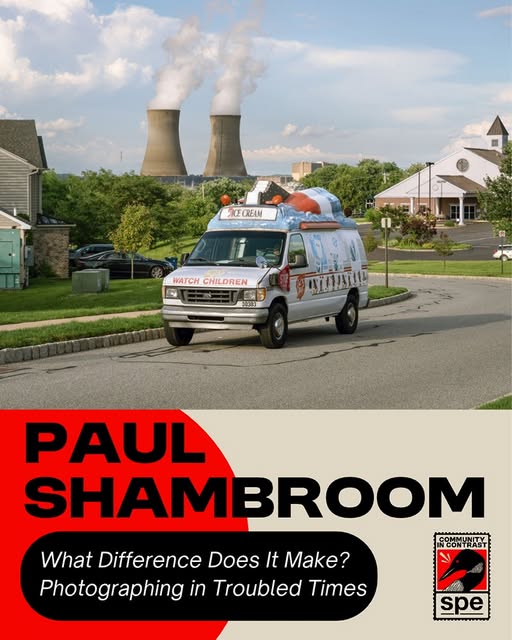
We’re excited to introduce Paul Shambroom, presenting “What Difference Does It Make? Photographing in Troubled Times”
“In 2020 17 year-old Darnella Frazier's cell phone video of George Floyd’s murder by Minneapolis police ignited international outrage. 100 years earlier Lewis Hine's photographs helped curtail child labor. In spite of growing doubts over the integrity of traditional and social media and eroding trust in photography's veracity, pictures can still make a difference. And we are increasingly aware that they can mislead and disrupt our democracy at the behest of moneyed and political interests.
The legacy of Hine’s photographs led to citizen-made images of the Rodney King beating, Frazier’s courageous video, and images of the recent murders by federal agents of Renée Good and Alex Pretti in Minneapolis.
At the SPE national conference in Minneapolis in 1985, the discourse discredited notions of photography as an agent of change. I was put off, and soon embarked on a series of projects exploring American military and political power, including the US nuclear weapons complex (1990s), small town council meetings (1999-2003), Homeland Security training sites after 9/11, and politically divided communities (2016-2024). I tried to balance my own skepticism about the efficacy of such work with optimism that it can make a difference.
My motivation at first was to see how close a regular guy with a camera could get to the levers of power. I came to believe that by pursuing my curiosity, my work could impact others. I didn’t think my photographs would end the nuclear arms race, but I believe they played a part in the conversation. Likewise, talking to people in conservative rural towns may help us understand how we come to our own beliefs, even if we disagree.
Photographing across the US for decades became my coping mechanism to endure our nation’s travails. My version of "If you don't laugh, you'll cry" has been “if you don’t photograph, you’ll cry.” Over the last difficult year it’s been hard to get out of bed, let alone believe that my photographs matter. I’ll get over it.”
About the Presenter
Paul Shambroom explores American power and culture. His subjects include small-town council meetings, the US nuclear arsenal, and politically divided communities. His four monographs are “Purpletown” (2024), “Past Time” (2020), Meetings” (2004), and “Face to Face with the Bomb” (2003), and a mid-career catalog "Picturing Power” (2008). He has received fellowships from the Guggenheim Foundation and others. His work has been in the Whitney Biennial and collected by the San Francisco MoMA, MoMA (NY), the Walker Art Center and the Art Institute of Chicago. He is a Professor Emeritus at the University of Minnesota.
Join us at the 2027 SPE Annual Conference to hear Paul reflect on four decades of photographing American power, politics, and communities, and consider photography’s capacity to document, challenge, and influence the world around us.


about 21 hours ago via Instagram
Congratulations to our 2027 High School Educator Award recipient, Vanessa Woods! We are excited for Vanessa's upcoming session, "The Photobook Reinvented: Photographic Experience in Book Form." "Rather than serving as a substitute for an exhibition, or a neutral format for reproduction, the photobook can operate as a materially specific space in which...
about 4 hours ago via Facebook
Meet the presenters of SPE’s 2027 Annual Conference! We’re excited to introduce Paul Shambroom, presenting “What Difference Does It Make? Photographing in Troubled Times” “In 2020 17 year-old Darnella Frazier's cell phone video of George Floyd’s murder by Minneapolis police ignited international outrage. 100 years earlier Lewis Hine's photographs helped curtail child labor. In spite of growing doubts over the integrity of traditional and social media and eroding trust in photography's veracity, pictures can still make a difference. And we are increasingly aware that they can mislead and disrupt our democracy at the behest of moneyed and political interests. The legacy of Hine’s photographs led to citizen-made images of the Rodney King beating, Frazier’s courageous video, and images of the recent murders by federal agents of Renée Good and Alex Pretti in Minneapolis. At the SPE national conference in Minneapolis in 1985, the discourse discredited notions of photography as an agent of change. I was put off, and soon embarked on a series of projects exploring American military and political power, including the US nuclear weapons complex (1990s), small town council meetings (1999-2003), Homeland Security training sites after 9/11, and politically divided communities (2016-2024). I tried to balance my own skepticism about the efficacy of such work with optimism that it can make a difference. My motivation at first was to see how close a regular guy with a camera could get to the levers of power. I came to believe that by pursuing my curiosity, my work could impact others. I didn’t think my photographs would end the nuclear arms race, but I believe they played a part in the conversation. Likewise, talking to people in conservative rural towns may help us understand how we come to our own beliefs, even if we disagree. Photographing across the US for decades became my coping mechanism to endure our nation’s travails. My version of "If you don't laugh, you'll cry" has been “if you don’t photograph, you’ll cry.” Over the last difficult year it’s been hard to get out of bed, let alone believe that my photographs matter. I’ll get over it.” About the Presenter Paul Shambroom explores American power and culture. His subjects include small-town council meetings, the US nuclear arsenal, and politically divided communities. His four monographs are “Purpletown” (2024), “Past Time” (2020), Meetings” (2004), and “Face to Face with the Bomb” (2003), and a mid-career catalog "Picturing Power” (2008). He has received fellowships from the Guggenheim Foundation and others. His work has been in the Whitney Biennial and collected by the San Francisco MoMA, MoMA (NY), the Walker Art Center and the Art Institute of Chicago. He is a Professor Emeritus at the University of Minnesota. Join us at the 2027 SPE Annual Conference to hear Paul reflect on four decades of photographing American power, politics, and communities, and consider photography’s capacity to document, challenge, and influence the world around us.